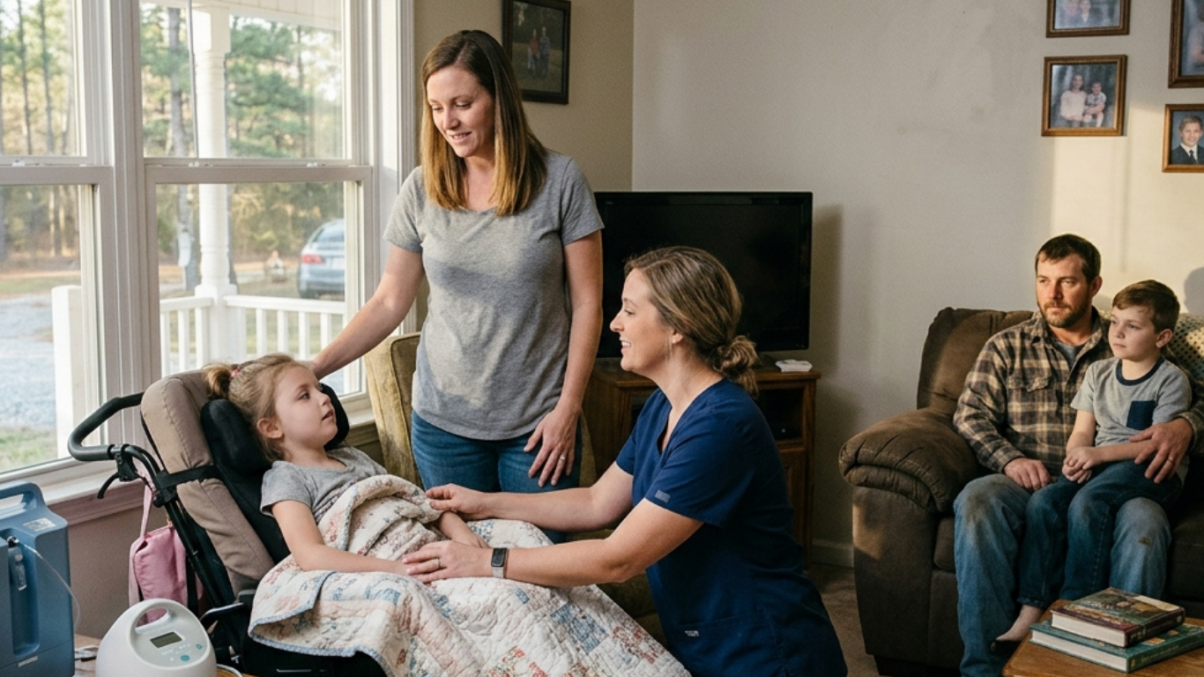
How Home Health Care Supports Families Facing Pediatric Anoxic Brain Injury in Alabama
Your child’s diagnosis can turn your whole world upside down. Suddenly, your days fill with doctors, tubes, and worries. Please know that you are not alone.
Pediatric anoxic brain injury affects the whole family, not just the child. Parents, brothers, sisters, and grandparents all feel the change. Together, you can build a calm and loving routine.
Home health care brings support to the place your family feels safest. This guide shows how it works for children with complex needs. At the end, you will see how Sunbridge Home Health Care helps families across Alabama.
What Anoxic Brain Injury Means for Your Family
Anoxic brain injury happens when the brain gets no oxygen. Doctors also call this cerebral hypoxia. The NINDS says brain cells can start dying within five minutes.
Drowning, choking, and cardiac arrest are some common causes. Birth problems can also lead to it. Most of the time, no one saw it coming.
Please remember that this is never your fault. Every child heals in a different way. Therefore, your care plan should fit your child and your family.
Over time, your care team can help you know what to expect. Doctors, nurses, and therapists each see a different part of your child’s progress. Ask questions often, and write down the answers.
Daily Life at Home With Complex Needs
Many families care for a child with several needs at once. For example, a child may have a G-tube, seizures, and a shunt. Another child may be blind, nonverbal, or both.
Here are some needs that many families manage at home:
- G-tube feeding and feeding pumps
- Seizures, including Lennox-Gastaut syndrome
- Shunt care
- Blindness or low vision
- Nonverbal communication needs
- Cerebral palsy and tight muscles
These needs can feel like a full-time job. Even so, many parents do it with great love. Still, no parent should have to do it without support.
The CDC calls cerebral palsy the most common motor disability in childhood. Also, about 4 in 10 children with cerebral palsy have epilepsy. As a result, many families juggle movement, feeding, and seizure care.
How Home Health Care Supports Pediatric Anoxic Brain Injury
Home health care brings a full care team to your door. A nurse watches your child’s health and gives medicines. A therapist can build strength, balance, and daily skills. Together, they help your child make steady progress.
Nurses also check vital signs and look for early warning signs. In addition, they teach you what to watch for. You learn to feel sure about each step.
Care at home happens right where your child lives. For instance, your child can practice at the same table where meals happen. Because of this, new skills fit into your family’s routine.
Goals are small and clear. One goal might be holding the head up for longer. Another might be sitting with less help. Each step counts, and your team celebrates it with you.
Care for Children With G-Tubes, Seizures, and Feeding Pumps
Feeding can feel scary at first. Nurses show you each step slowly. They help with G-tubes, feeding pumps, and tube site care. In time, many parents feel more sure.
Seizures can be frightening to watch. The NINDS describes Lennox-Gastaut syndrome as a severe form of epilepsy. Its seizures usually start before age four. Your care team helps you track seizures and plan what to do.
Children with shunts, blindness, or no speech need special support. For example, caregivers can use touch cues with a blind child. They can also use pictures and simple devices for nonverbal children. This way, your child can share needs and feelings with you.
Safety comes first with every feeding and every seizure. Your team can post simple steps on the fridge. As a result, anyone who helps your child knows what to do.
Why Families Choose Care at Home
Home care saves you long and tiring trips. Medical devices make travel hard for many children. Staying home also lowers stress and limits exposure to germs.
You become a key part of the team. Your nurses coach you on safe lifting, feeding, and positioning. As a result, you feel stronger and more confident.
Brothers and sisters can join in, too. Grandparents can learn simple ways to help. Moreover, your child stays close to the people who love them most. Every small gain, like a smile or a head turn, is worth celebrating.
Home care can also give you more peace of mind. You see who comes into your home. You know your child is in a familiar place.
Home Health Care for Medically Fragile Children in Alabama
Alabama families facing pediatric anoxic brain injury deserve skilled care close to home. Sunbridge Home Health Care serves families across the state. Its main office is in Decatur, Alabama.
Sunbridge provides nursing care for medically fragile children. It also works with children who have long-term care needs. Referrals usually include doctor orders and a plan of care.
Whether you live in a city or a small town, help may be near. Ask the team about service in your area. They can explain what is possible for your family.
What Sunbridge Offers Alabama Families
The Sunbridge team offers skilled nursing and private duty nursing. They also support infusion services and complex care management. These services can help children who use tubes, pumps, and other devices.
The team values family-centered care. They want to know your child as a person. In addition, they listen to your hopes and your worries.
Every child’s needs are different. So, ask which services fit your child best. The intake team can answer your questions.
What to Expect When You Reach Out
Starting care is simpler than many parents expect. First, a hospital, doctor’s office, or agency can send a referral. You can also call the team to ask questions.
Referrals usually include a clinical summary and a plan of care. They also include doctor orders and a current medicine list. Insurance details and contact information are needed too.
According to the Sunbridge referral page, intake usually contacts families within one business day. After that, the team talks with you about next steps. You can also call (256) 580-5800 to ask questions.
Tips for Families Starting Home Care
Start by writing down your child’s daily routine. Include feeding times, medicines, and seizure notes. This helps your care team learn your child fast.
Next, list your top questions and worries. Bring them to your first visit. Moreover, no question is too small.
Finally, take care of yourself too. Rest, ask for help, and lean on family. A strong caregiver helps a child thrive.
Conclusion
Pediatric anoxic brain injury is hard, but your family has options. Home health care supports feeding, medicines, seizure safety, and daily comfort. Above all, it keeps your child close to home.
Whether your child has a G-tube, shunt, or feeding pump, help is here. Children with seizures, cerebral palsy, or Lennox-Gastaut syndrome can benefit too. Therefore, please do not wait to ask about in-home care.
Ready to take the next step? Reach out to Sunbridge Home Health Care today. Our team will walk beside your Alabama family from there.