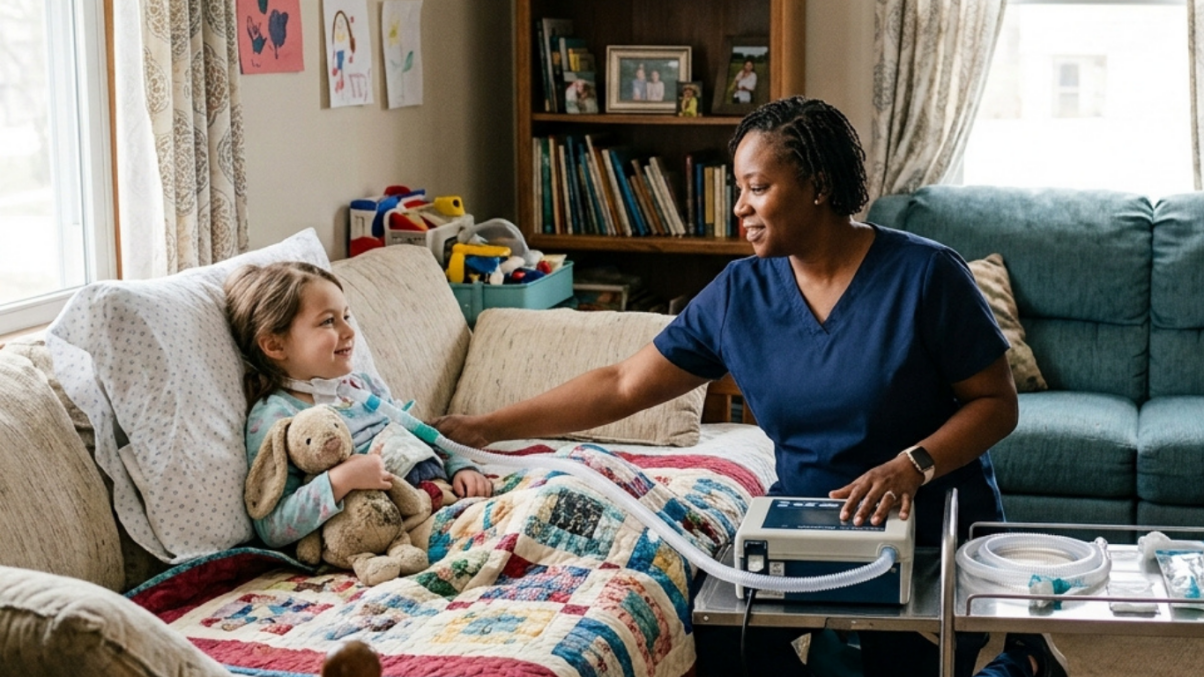
Pediatric home ventilator care lets children with serious breathing problems live at home. Many of these children also need oxygen support every day. Home gives them comfort, family time, and a chance to grow.
Health experts say more children now rely on home-based care for daily health. A national study of providers in 45 states backs this up. It says the number of children on home ventilators is growing. Most of them receive that care at home.
This article explains how home care works for these children. It also shares research and health data from Alabama and the United States. Finally, it shows why partners like Sunbridge Home Health Care matter today.
One reason for this growth is better newborn care. USA Health notes that more infants now survive conditions that were once fatal. Many of these children then need long-term breathing help. This makes pediatric home ventilator care more important than ever.
Understanding Pediatric Home Ventilator Care and Oxygen Support
A ventilator is a machine that helps a child breathe. Some children use it all day, while others use it only at night. Many also use extra oxygen to keep their blood oxygen at a safe level.
Many health problems can lead to this kind of care. Examples include lung disease from early birth, airway defects, and muscle diseases. Spinal cord injuries can also cause the need.
Oxygen therapy often goes hand in hand with pediatric home ventilator care. In a study from China, 29 babies went home on oxygen. All of them were off oxygen within the first year. Half used it for about 25 days or less.
Doctors use home ventilation to help children live longer. It also aims to protect their quality of life. Another goal is to cut down on health problems over time. Dutch researchers describe these same aims.
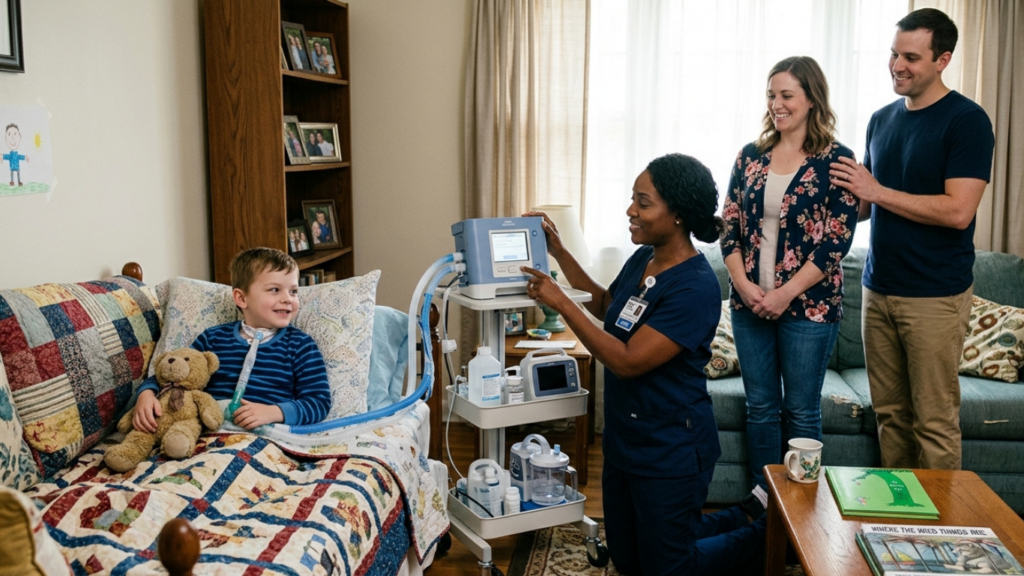
Good pediatric home ventilator care also needs a full team. Nurses watch breathing and check the equipment. Therapists, doctors, and parents work together every day. Because each child is different, the plan must fit that child.
What Daily Life Can Look Like at Home
Every family’s routine is different, but home ventilator care tends to follow a steady rhythm. Caregivers check the child’s breathing and the equipment at set times. They clean and prepare supplies, track oxygen readings, and watch for any change in how the child looks or sounds. Nurses often help with these checks, so parents can rest and spend time simply being parents.
A child on a home ventilator can still do many of the things other children do. Many play, listen to stories, and take part in family meals. Some go to school or therapy visits with the right plan and support in place. The goal is not only to keep a child breathing safely. It is also to give that child a childhood.
Home also changes how a family lives. Parents learn new skills, and siblings often learn to help in small ways. Routines for sleep, travel, and meals may need extra planning. With trained nurses and a clear care plan, those changes become easier to manage over time.
What Research Says About Children on Home Ventilators
Research shows how fast pediatric home ventilator care has grown. One Dutch center tracked children over 30 years. The count rose from 8 children in 1979–1988 to 122 in 1999–2008.
The same study followed 197 children who started home ventilation. At the end, 68 percent still used a ventilator. About 6 percent had been weaned off the machine. This shows the care is often long term.
Hospital stays are another concern for these families. Researchers say children on home ventilators often face long stays and frequent readmissions. However, another study links home health care to fewer hospital readmissions.
Home oxygen studies also bring some good news. In the China study, home oxygen was not linked to more readmissions. Growth and brain development were also similar between the groups. However, babies on oxygen had more wheezing after discharge.
Some children need more intense help than others. The Dutch study found that young children on invasive ventilation had very long ICU stays. Those findings show why a safe path home matters. Pediatric home ventilator care can also help free hospital beds for other children.
What These Findings Mean for Families
The research points in one direction. Home care is growing, and it is often long term. Families should expect to plan for months or years, not weeks. That is why training, equipment checks, and reliable nursing matter from the very first day at home.
The studies also show that outcomes depend on support. When a child has skilled help close by, small problems can be noticed early. When families carry the whole load alone, stress builds and gaps in care become more likely. Strong home health support is part of what makes the move from hospital to home safe.
No single study answers every question for every child. Each child’s lungs, airway, and health history are different. For that reason, families should talk with their child’s doctor about what the research means for their own situation.
Health Data From Alabama and the United States
Pediatric home ventilator care matters in Alabama, where many children need extra medical help. A KFF review of 2024 survey data gives Alabama a rate of 28.8 percent. This rate counts children ages 0 to 17 who meet a broad definition. That is nearly 3 in 10 children.
A medical home means care that is steady and well coordinated. America’s Health Rankings reports that children without one face more unmet needs. Those with special needs are almost three times as likely to have unmet needs.
Alabama also has strong hospital programs for these children. Children’s of Alabama offers a complex care program for children who use tools like oxygen. The University of South Alabama runs a similar pediatric clinic. Still, families need steady nursing help once they go home.
Alabama is also working to improve care coordination. A state team joined the University of South Alabama clinic and Children’s Rehabilitation Service. Together, they built a shared plan of care and hired a care coordinator. The goal is better communication between providers and families.
Nurses do much of the daily work in these homes. A Medicaid study looked at children who use medical technology. Of these children, 77.2 percent received RN or LPN care. This shows why skilled nursing is central to pediatric home ventilator care.
Questions Alabama Families Can Ask Before Discharge
Because the hospital programs and the home team are separate, families do best when they ask clear questions early. These questions can help:
- Who will train each caregiver, and how many caregivers should be trained?
- Which agency will provide nursing at home, and how many hours of care are approved?
- What equipment and supplies will arrive before we leave the hospital?
- Who do we call first if something changes at night or on a weekend?
- Is there a care coordinator who can keep the hospital, doctors, and home team connected?
Asking these questions before discharge gives the care team time to answer them. It also helps families feel more ready on the first night at home.
Why Sunbridge Home Health Care Matters Today
Sunbridge Home Health Care supports families who need pediatric home ventilator care across Alabama. Its nurses are RNs and LPNs, backed by therapy partners. The team also offers training and services in trach care, G-tube care, and ventilator support. Its nurse scheduling is dependable, with 24/7 availability.
Today, many families struggle to find trained home nurses. Health Affairs reports that too few home health providers have pediatric training. As a result, family caregivers often carry the nursing load alone. That can hurt their jobs and their own health.
Sunbridge also keeps the start of care simple. After a referral, its team usually contacts the patient or caregiver within one business day. In most cases, Alabama Medicaid approval takes about seven days. Meanwhile, care coordinators guide discharge planning.
Sunbridge also works with many types of insurance. It takes part in commercial, Medicaid, and managed care plans. Its intake team checks coverage during the referral process. They also explain any approval rules to families.
Even if your family does not have private insurance, Sunbridge can still help provide ventilator services for your child. Home ventilator care should not depend on the type of coverage a family has, so the team will work with you to find a path forward.
Strong teamwork with doctors keeps care safe and steady. Sunbridge manages physician orders and medication changes. Its team shares updates when a child’s condition changes. As a result, doctors and families stay on the same page.
Support That Reaches Beyond the Nursing Shift
Good home care is more than the hours a nurse is in the room. Sunbridge works to keep the whole care team connected. Its coordinators help with discharge planning, and its intake team walks families through approval steps so they are not left guessing. Nurses who are trained in trach care, G-tube care, and ventilator support can handle several parts of a child’s daily needs in one visit.
Training matters just as much for parents. Families can learn the routines they will use every day, and nurses can reinforce those steps at home. Over time, that shared knowledge builds confidence for everyone caring for the child.
Sunbridge also understands that families come to home care from many starting points. Some are leaving a long hospital stay. Others are managing a new diagnosis. Some have cared for their child at home for years and need more skilled help. Whatever the starting point, the team’s goal is the same: safe, steady care that lets the child stay home.
How Families Can Get Ready for Home Care
Good planning makes pediatric home ventilator care smoother for everyone. First, ask the hospital team about caregiver training before discharge. Next, ask who will provide nursing help at home.
Sunbridge usually asks for a few key documents with each referral. Having them ready can speed things up. The list below shows what to gather.
- Clinical summary
- Plan of care and physician orders
- Current medication list
- Contact details for the patient or caregiver
After that, keep a simple care notebook at home. Write down ventilator settings, oxygen readings, and any changes. Share these notes with your nurse and doctor. Also, make sure everyone knows whom to call in an emergency.
Plan for emergencies early, because pediatric home ventilator care never takes a day off. Ask your care team what to do during a power outage. Keep key phone numbers in one easy place. Then, practice the steps with every caregiver.
Parents need support too. Ask your care team about respite and family help. Sunbridge also shares family resources on its website. Taking short breaks helps parents stay strong for their children.
Frequently Asked Questions About Pediatric Home Ventilator Care
Can a child really live at home on a ventilator?
Yes. Many children receive ventilator support at home, and research shows that most children on home ventilators are cared for there. The key is a safe plan, trained caregivers, and skilled nursing support.
Who provides the nursing care?
RNs and LPNs usually provide skilled nursing at home. In one Medicaid study of children who use medical technology, 77.2 percent received RN or LPN care. Sunbridge’s nurses are RNs and LPNs, with therapy partners to support the care plan.
What if my family does not have private insurance?
Sunbridge can still help provide ventilator services for your child, even without private insurance. Its intake team reviews coverage during the referral process and explains any approval rules. In most cases, Alabama Medicaid approval takes about seven days.
How quickly can care begin?
After a referral, the Sunbridge team usually contacts the patient or caregiver within one business day. Care coordinators then help guide discharge planning so the move home goes smoothly.
Will my child always need a ventilator?
It depends on the child. In the Dutch study, 68 percent of children were still using a ventilator at the end of follow-up, and about 6 percent had been weaned off. Your child’s doctor can explain what to expect based on your child’s condition.
Who can send a referral?
Hospitals, physician practices, and public agencies can refer families to Sunbridge. Families can also reach out on their own through the referral page.
Safe Care at Home Starts With the Right Partner
Pediatric home ventilator care gives children a chance to heal and grow at home. Research shows this need has grown over many years. Alabama families see the same need in their own communities.
However, home care only works when skilled nurses are available. Trained nurses ease the load on parents and support steady care. Therefore, trusted agencies matter more than ever today.
Hospitals, doctors, and public agencies can refer families too. Sunbridge accepts referrals from hospitals, physician practices, and public agencies. Its intake team reviews each referral promptly. Families without private insurance are welcome to reach out as well. Use the button below to start pediatric home ventilator care sooner.
Refer a family today: https://sunbridgehhc.org/patient-referrals/